
Overview
In this section you will get an overview of the condition and its relevance to your health.
Hair loss is one of the most common dermatological problems in men. Approximately 80 percent of all men are affected at some point in their lives — many as early as their 20s or 30s. By far the most common form is androgenetic alopecia, or hereditary hair loss.
Although hair loss is not a disease in the strict sense, it can significantly affect self-confidence. The good news: With early treatment, hair loss can be stopped in most cases, and sometimes hair even grows back.
What is it?
Here you will learn what medically characterizes this condition and how it is defined.
In androgenetic alopecia, the hair follicles are excessively sensitive to dihydrotestosterone (DHT), a metabolite of the male sex hormone testosterone. DHT causes the hair follicles to shrink, the growth phase of the hair shortens, and the hair becomes progressively thinner until it eventually falls out completely.
The pattern of hair loss is typical: First, receding temples (widow's peaks) develop. Later, the hair thins at the crown. As it progresses, these areas can merge until only a horseshoe-shaped ring of hair remains on the sides and back of the head. The back of the head is usually spared because the hair follicles there are less sensitive to DHT.
The predisposition to this type of hair loss is inherited — interestingly, the genes can come from either the mother or the father. Looking at a grandfather or uncle therefore gives only limited insight into one's own risk.
Causes
The following information explains which factors can contribute to the development of this condition.
The main cause of androgenetic hair loss is genetic: certain genes make the hair follicles sensitive to DHT. This hormone is produced by the conversion of testosterone through the enzyme 5-alpha reductase.
Importantly: It is not caused by high testosterone levels. Men with hair loss often have completely normal hormone levels — their hair follicles simply react more sensitively to DHT.
Besides androgenetic alopecia, there are other forms of hair loss that are much less common:
Alopecia areata (patchy hair loss) is an autoimmune disease in which the immune system attacks the hair follicles. Typical round, bald patches develop.
Diffuse hair loss can be triggered by nutrient deficiencies (especially iron, zinc, biotin), thyroid problems, stress, medications, or infections. The hair becomes uniformly thinner across the entire scalp.
Scarring hair loss is caused by inflammation, injuries, or skin diseases that permanently destroy the hair follicles.
Symptoms
This section describes the typical signs and symptoms you should watch for.
The first sign of androgenetic alopecia is usually receding temples. The hairline retreats at the temples while initially remaining intact in the middle. Later, the parting area may thin and a bald spot may develop at the crown.
In some men, hair loss starts directly at the crown without the temples being affected. The progression varies from person to person and can span years or decades.
Unlike other forms of hair loss, the scalp does not usually itch or flake with androgenetic alopecia. If such symptoms occur, a doctor should rule out other causes.
Some hair loss of 50 to 100 hairs per day is entirely normal, by the way. Only when significantly more hair falls out or visible bald patches develop is there a problem.
Diagnosis
Below you will learn how this condition is detected through medical examinations.
Androgenetic alopecia can usually be diagnosed simply by observing the typical pattern of hair loss. A dermatologist can perform a hair analysis (trichogram) if needed, in which the proportion of hairs in different growth phases is determined.
If the hair loss follows an atypical pattern — for example, diffusely across the entire scalp or with signs of inflammation — blood tests may be useful to rule out other causes: thyroid function, iron levels, zinc, and possibly hormone status.
For online treatment with finasteride, a description of the hair loss pattern and a photo are usually sufficient to identify typical androgenetic alopecia.
Treatment
Here the available therapy options and their modes of action are explained.
Treatment of androgenetic alopecia targets the cause: if DHT is damaging the hair follicles, then either DHT production must be inhibited or the hair follicles must be strengthened by other means.
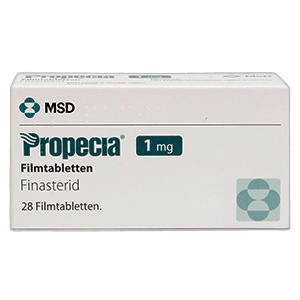
Finasteride (1 mg daily) inhibits the enzyme 5-alpha reductase, reducing DHT levels in the body by about 70 percent. This protects the hair follicles and allows them to recover. In about 80 percent of users, hair loss stops, and in some, hair even grows back. The effect begins after three to six months and lasts as long as the medication is taken.
Possible side effects of finasteride affect about 2 percent of users: reduced libido, erectile problems, or decreased ejaculate volume. These side effects are generally reversible after discontinuation.
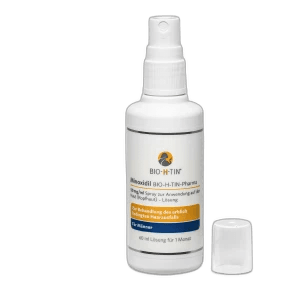
Minoxidil is a solution or foam applied twice daily to the scalp. It promotes blood circulation and extends the growth phase of the hair. Minoxidil works independently of the DHT mechanism and can also be used in combination with finasteride. It is available without a prescription.
Hair transplantation is an option for men with advanced hair loss. Hair from the back of the head — where it does not respond to DHT — is transplanted to the bald areas. Modern techniques (FUE) allow for natural-looking results.
Important: The earlier treatment begins, the better the results. Hair that has already fallen out and been lost cannot be brought back with medication — the primary goal is to prevent further loss.
Available medications
Various prescription medications are available for treatment. Click on a medication to learn more about its effects, dosage and side effects.

Prevention
This section provides guidance on prevention and reducing risk factors.
Not every form of hair loss can be prevented. In androgenetic alopecia, the predisposition is genetic.
A healthy lifestyle, balanced diet, and stress reduction can help positively influence the hair cycle. Nutrient deficiencies — especially iron, zinc, and biotin — should be avoided.
Above all, early initiation of treatment is crucial: the earlier therapy begins, the more hair can be preserved.
FAQ
Here you will find answers to frequently asked questions on this topic.
Would you like a medical assessment?
Fill out the medical questionnaire. A licensed doctor will review your information and recommend a suitable therapy if appropriate.
Important notice
This content is for general information only. In case of severe pain, shortness of breath, impaired consciousness, fever > 39°C or rapidly worsening symptoms, please seek immediate medical help ().
Related treatments
More treatments from the Männergesundheit area that might interest you.
Erektionsstörungen
Beantworte ein paar kurze Fragen, damit wir einschätzen können, ob eine Behandlung medizinisch geeignet ist.
Vorzeitiger Samenerguss
Ein kurzer, strukturierter Fragebogen hilft, passende Optionen medizinisch einzuordnen.
Testosteronmangel
Ein kurzer Check der wichtigsten Faktoren hilft, den nächsten sinnvollen Schritt einzuordnen.